| Donate | Contact Us | Materials | Subscribe | Israel-Palestine Timeline | Israel-Palestine News | |
 |
|
Understanding the Crisis in GazaImportant Facts and ContextNote: This page gives information about the situation in Gaza prior to the violence which began on October 7th, 2023.
BackgroundIsrael was created in 1948 through a political movement that had begun in Europe in the 1800s. Known as Political Zionism, the goal of this secular movement was to create a Jewish state in Palestine, even though at that time the population of Palestine was 85% Muslim, 15% Christian, and 4% Jewish. This movement eventually succeeded with Israel’s founding war, termed its “war of independence,” in which three-quarters of a million Palestinians were violently pushed out and Israel was established on 78% of Mandatory Palestine. Although in 1949 the United Nations affirmed the refugees’ right to return to their land, Israel has not allowed them to return to their homes because they are not Jewish.
In 1967, Israel launched a war against its neighbors, and conquered the rest of Palestine — the West Bank and the Gaza Strip – and began a decades-long military occupation. Israel began confiscating large swaths of Palestinian land in these occupied territories and moving Jews onto it. These colonies, which are illegal under international law, are called settlements. Palestinians and other non-Jews are not allowed to live in them. Gaza: An Open-Air PrisonIn 2005, Israel removed its settlements from Gaza, resettling the inhabitants in Israel and the West Bank (where today over 620,000 Israelis live illegally on Palestinian land), but continued to control all exits and entrances, its air space, and its seaports. In effect, Gaza became an open-air prison for its approximately 2.1 million inhabitants (75% of whom are from families expelled from their land by Israel in its founding war to create a Jewish state). In 2006, in what was universally hailed as a free, democratic election, Palestinians elected members of Hamas, a Palestinian political party with a militant wing, to a majority of the seats in the Palestinian legislature. A unity government of Hamas and the former ruling party, Fatah, was formed. Israel was not happy with this result and has worked ever since to undermine it. Western powers declared a boycott of the Palestinian Authority as long as Hamas was included in the government. In 2007, this pressure caused the government to splinter, with Hamas in charge in Gaza, and Fatah in control in the West Bank. Israel then instituted a strangling blockade of Gaza (expanding its earlier blockades), which has remained in place ever since. Israel consistently blocks the food, medicine, and other essential supplies needed by the population of Gaza, and has created a humanitarian disaster:
In 2021, Israel rejected, delayed, or ignored 36 percent of over 15,000 patients’ requests for permits to exit Gaza for medical care. Here is one example of this situation. Imbalance of Power and Loss of LifeIsrael has invaded and shelled Gaza frequently over the past 20 years. Resistance groups in Gaza attempted to fight back, and some Palestinian fighters began launching rockets against Israeli towns. The first one was launched from Gaza in October 2001. Often described as a significant threat to Israeli security, most of these rockets are small, homemade projectiles that normally kill no one and only rarely cause damage. Since 2001, these have killed 28 Jewish Israelis, as well as 2 foreign workers and 4 Palestinians in Israel (as of May 2023). Many of the casualties have been in Israeli town of Sderot, which was created on the rubble of Najd, a Palestinian town that had been ethnically cleansed in 1948. Israeli forces, on the other hand, are one of the strongest militaries on earth, and are equipped with massive, modern weaponry, much of it supplied by American taxpayers: F-16s, helicopter gunships, tanks, armored vehicles, nuclear weapons, etc. Palestinian weapons are no match. Since September 2000, Israeli Defense Forces have killed at least 9,560 Palestinians, the majority of them in Gaza. While Israeli violence is often described as retaliatory, the fact is that in nearly all cycles of violence Palestinians are killed first. In the uprising that began in fall of 2000, 91 Palestinian children were killed before a single Israeli child was killed. Since the permanent blockade began in 2007, Israel has launched a number of attacks on the people of Gaza. Israeli Invasion of Gaza Dec 27, 2008 — Jan 18, 2009After two years of Israel’s brutal blockade and Palestinian resistance, on June 19, 2008 a 6-month truce went into effect between Israel and fighters in Gaza. The terms of the truce were that Israel stop all invasions into Gaza and reduce its blockade on Gaza, and that Palestinians stop all rocket attacks on Israel. Although Hamas complied, Israel never fulfilled its obligation to ease the siege of Gaza, which had created, according to numerous relief organizations, “catastrophic” humanitarian conditions. Christian Aid appealed to Israel to stop withholding food and medicine as collective punishment (which violates international humanitarian law) against Gaza’s 1.8 million men, women, and children (70-80% of whom are refugees, or their descendants, from 1948). The truce did not last the full six months: while Gazan resistance maintained the ceasefire, Israel killed 6 Palestinians in Gaza on November 4th – the day that the world’s attention was on Barack Obama’s election as President of the United States. Hamas retaliated against the killings by shooting rockets toward Israel. The media reported this and claimed that Hamas was the instigator.
On December 27th, Israel began a premeditated air, land, and sea assault on Gaza that reduced large areas to rubble. Like shooting fish in an over-crowded barrel. In three weeks Israeli forces killed 1,417 Palestinians — 313 of them children — and injured 5,303. Palestinians killed 9 Israelis during this time. Israeli strikes damaged and destroyed huge numbers of homes, causing a third of all Gazans to be displaced at some point during the assault. According to the WHO, “Vital infrastructure has been compromised or destroyed, resulting in a lack of shelter and energy sources, deterioration of water and sanitation services, food insecurity and overcrowding.” After ignoring calls for a ceasefire for 3 weeks, Israel finally declared what it called a “unilateral ceasefire” on January 18th. Palestinian factions called a ceasefire as well a few hours later. Subsequent Ceasefire ViolationsIt was widely reported by the media that this ceasefire was first breached by Palestinians on January 27th 2009. In reality, however, Israel had already violated the ceasefire at least seven times, including killing two farmers — the first only a few hours after the ceasefire went into effect — and shooting a child. A study conducted of all the ceasefires, truces, and periods of calm during 2000-2008 concluded: “...a systematic pattern does exist: it is overwhelmingly Israel, not Palestine, that kills first following a lull. Indeed, it is virtually always Israel that kills first after a lull lasting more than a week.” 2012 Israeli invasion of GazaIn 2012, Israel initiated another lopsided war against Gaza, beginning with the assassination of Hamas leader Ahmed al-Jabari. Al-Jabari had nearly completed the process of negotiating a permanent ceasefire with Israel, but Israel’s military preferred violence.
The invasion lasted 8 days, during which 6 Israelis (4 civilians and 2 soldiers) died, along with 174 Palestinians (between 60 and 109 were civilians). 2014 Israeli invasion of Gaza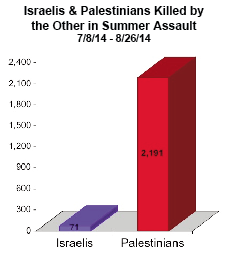
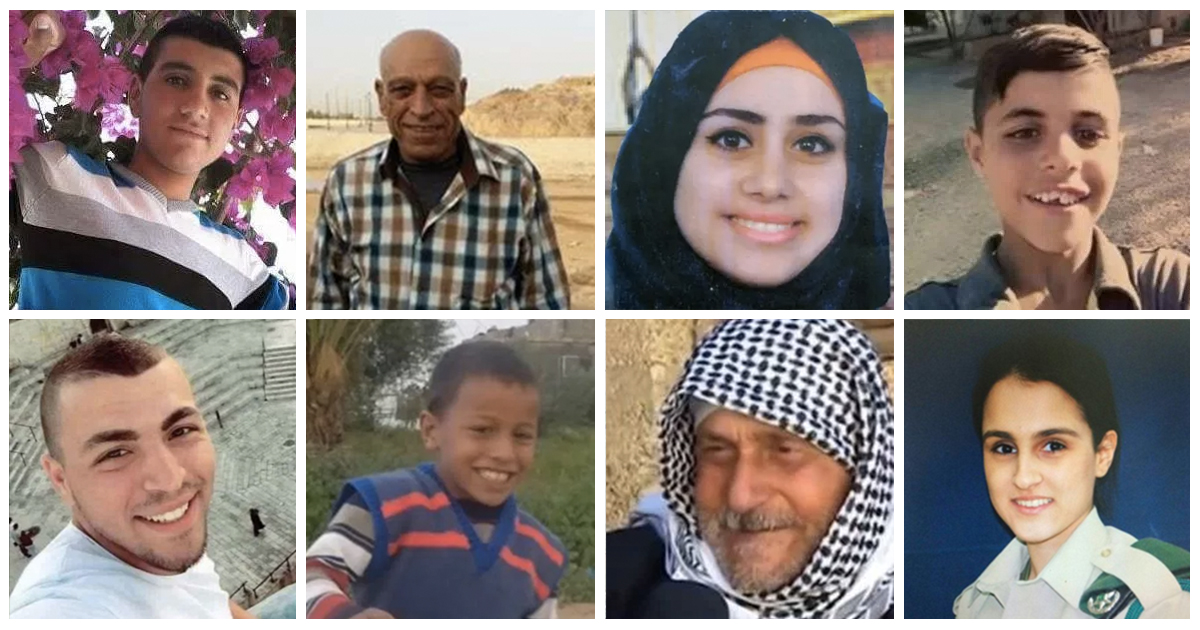
In the summer of 2014, the Israeli military killed 185 Palestinians in 8 days before the first Israeli was killed on July 15th. Israel began with airstrikes, then switched to a ground invasion. The incursion ended with 66 Israeli soldiers and 6 Israeli civilians dead - one of which was a child. In Gaza, about 2200 Palestinians were killed - of which 700 were fighters and 1500 civilians, including 500 children, 16 health care workers, and 9 journalists. 116,000 Gazan homes were damaged or destroyed, leaving over 100,000 people homeless; 216 Gazan schools, 67 Gazan health care facilities were damaged or destroyed. Of the 11,000 Gazans injured, 3,300 were children; 1,000 of them are permanently disabled. More than 1,500 Palestinian children were orphaned. About 550 Israelis were injured, 16% of them civilians. The Great Return March: 2018-19On March 30th, 2018, an estimated thirty thousand Palestinian civilians organized along the Gazan border fence for a massive unarmed protest against the Israeli occupation and to call attention to their right to return to their land. The protest was dubbed “The Great Return March.” This continued every week until December 27, 2019. Israel responded to the Great Return March by stationing over 100 snipers along the border with ‘shoot to kill’ orders.
May 2021 Assault on GazaAfter a month long wave of aggression against Palestinians by Israeli military and settlers, Israeli soldiers stormed the Al-Aqsa Mosque in Jerusalem, prompting Hamas to launch rockets into Israel and kicking off 15 days of Israeli airstrikes, causing mass death and destruction. By the time a ceasefire was called on May 21st, 253 Gazans had been killed, including 66 children, and 1,948 Gazans had been injured. 12 Israelis were also killed, including 1 child, and 324 were injured. See here for a more detailed account of these events.
August 2022 Assault on Gaza
May 2023 Assault on Gaza
Americans are InvolvedAmerican taxpayers give Israel more than $10 million per day — far more than to all the starving countries of Africa put together – positioning us as responsible for Israeli violations of human rights. In the United Nations, the US has frequently vetoed resolutions to restrain Israeli violence, alienating our country from most of the world. US policies are largely driven by a special interest lobby on behalf of Israel. Until more Americans become informed and active on this issue, such policies - which fund violence, prevent peace, and cause dangerous and unnecessary hostility against the United States - will continue. Important Statistics
Infographic on back: (The flyer is accurate up to 2019. Some additional information has been added to this page since then.)  |
|
||||||||||||||||||||||||||||||||||||||||||||||||||||||||||||||||||||||||||||||||||||||||||||||||||||||||||||||||||||||||||||||||
|
If Americans Knew distributes and posts to our website copyrighted material, sometimes without the permission of the copyright owner. We are making such material available in our efforts to advance understanding of the Israel/Palestine conflict. We believe this constitutes a ‘fair use’ of any such copyrighted material as provided for in section 107 of the US Copyright Law since it is being distributed without profit for purely educational purposes. For more information go to: http://www.law.cornell.edu/uscode/17/107.shtml. If you wish to use copyrighted material from this site for purposes of your own that go beyond ‘fair use’, you must obtain permission from the copyright owner. This website is printer-friendly. Please Print this article and share it with your friends and family. IF AMERICANS KNEW |
|||||||||||||||||||||||||||||||||||||||||||||||||||||||||||||||||||||||||||||||||||||||||||||||||||||||||||||||||||||||||||||||||